Guide / Setup
HelpPrice book
The items and assemblies that feed every quote and invoice, plus the screens that shape how they're priced and kept tidy: price levels, line templates, catalogue groups and a catalogue health check.
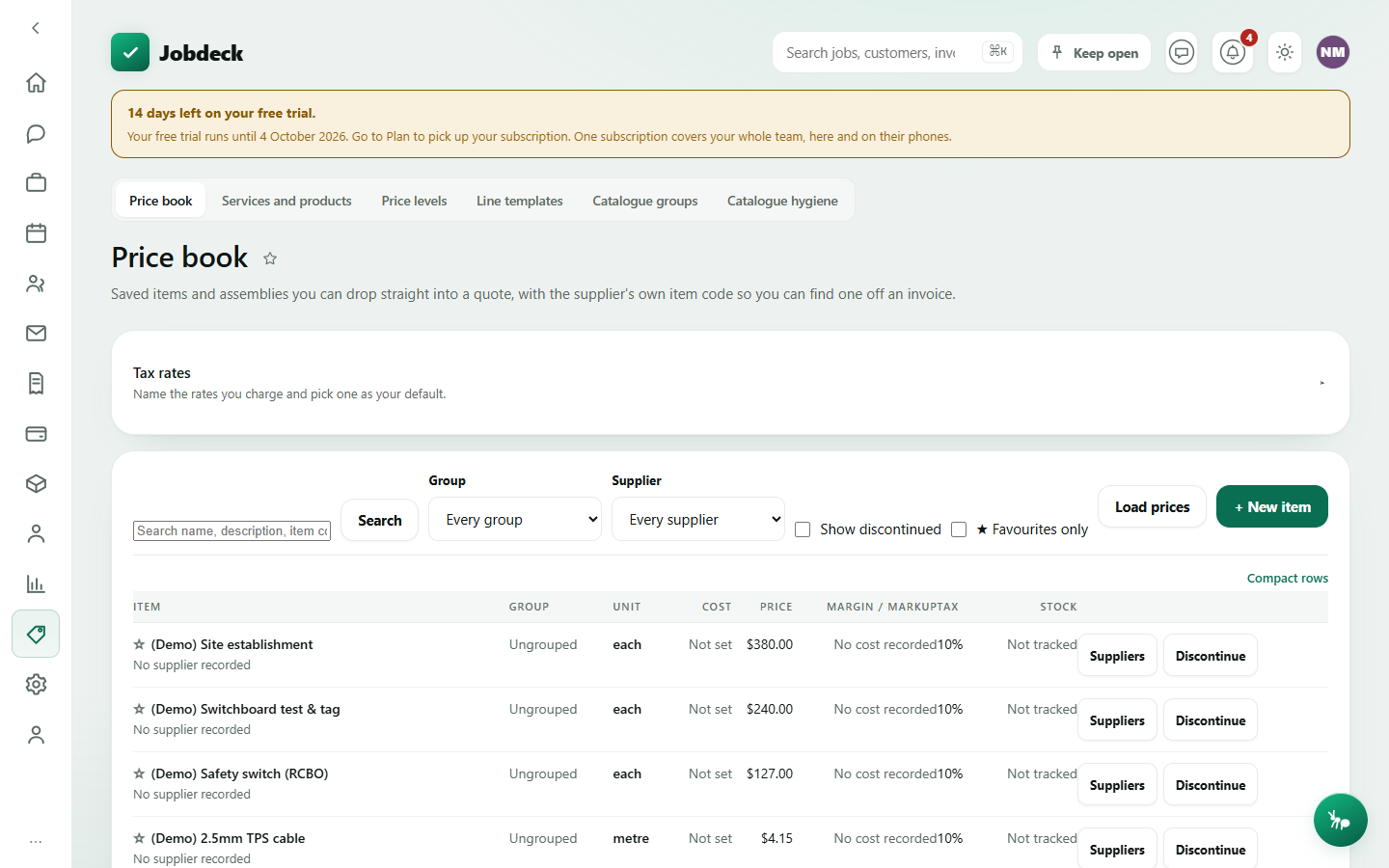
Price book /price-book
- What it's for
- Reusable priced items and assemblies you can drop straight into a quote, carrying the supplier's own item code so you can find a line again off an invoice.
- Controls
- Search (name, description, item code, barcode); Group filter; Supplier filter; Show discontinued; ★ Favourites only.
- Buttons
- + New item → Save item; Load prices (opens a wholesaler price-list importer and the starter catalogue); per-item Suppliers (the other suppliers it's bought from, each at their own price — only offered to a reader who can see cost); per-item Discontinue / Bring back.
- On the page
- A table of items: name (with a ★ favourite star and an "Indicative price" flag for anything still carrying the starter catalogue's price, never repriced), group, unit — and the buying unit too where it differs, e.g. priced per metre, bought as a 100m drum — cost and margin/markup, price, tax rate, and stock on hand or "Not tracked". A tax rates panel for the named rates a row can fall back to.
There is no delete, on purpose — an item on last year's quotes must not vanish. Discontinue just drops it out of the pickers; Show discontinued brings it back into view for reading history.
Cost and margin only appear for a reader with the view_money permission — the server drops the field entirely rather than sending a blank, so a cost column either isn't there or is real.
What else is filed here
Five more screens sit under Price book. The first is what the business sells rather than what it stocks; the rest shape how the catalogue above gets priced, reused and kept clean.
Services and products /services
- What it's for
- What the business sells, as distinct from what it buys and stocks in the price book above. A service sets how long to allow for the job and what it's worth, and whether a customer can book it themselves on your online booking page — anything ticked bookable is something a stranger can put straight into your diary, which is why that tick is spelled out rather than a bare checkbox.
- Buttons
- Add a service → Add it; per-service Save, Delete.
- On the page
- A list of services, each optionally linked to a job template (how the job gets built) and a checklist, so booking a service also sets up how it's actioned.
Price levels /pricing-levels
- What it's for
- More than one price list — a retail price, a trade price, or a rate for the builder who gives you forty jobs a year — instead of remembering to discount every quote by hand. A customer sits on a level, and a level can set an explicit price for an item, a markup on cost, or a blanket markup on everything.
- On the page
- A live preview showing which rule actually won for any item — most specific first — because "why is this price what it is" needs an answer somebody can see.
Needs the manage_settings permission to create, rename or delete a level.
Line templates /line-templates
- What it's for
- The quote and invoice lines you type over and over, saved once and applied in a click. Reachable until now only from a dropdown on the Quotes list — this is the first screen where you can see what templates exist, read what's on one, and edit it directly.
Needs issue_quotes or invoicing — the screen switches between a quote-template list and an invoice-template list, and holding either permission opens the half that's yours.
Catalogue groups /catalogue-groups
- What it's for
- The price book as a tree, up to four levels deep — Cable > Glands > Brass > 25mm — so somebody who doesn't already know an item's exact name can still find it, the way an apprentice finds a gland in a printed wholesaler catalogue.
- On the page
- The tree, read straight off the server in its real draw order rather than rebuilt on screen.
Catalogue hygiene /catalogue-hygiene money
- What it's for
- A health check on a catalogue that's grown to thousands of lines. It finds the same part entered twice under different names, a duplicate item code, a line nobody's ever quoted, a sell price with no cost behind it (so every job that touches it reports a margin that isn't real), and an archived item still sitting on a quote that hasn't gone out yet.
- On the page
- A list of findings, each with a plain-English fix attached — a hygiene report that only counts problems gets read once and ignored, so every row also says what to do about it.
Needs view_money, or the free read-only accountant seat — half of what it finds is cost data, and "no buy price recorded" is itself a statement about cost.